How to Scope an MVP: The Thing Founders Overestimate Isn't Features, It's Timeline
A good MVP isn't a smaller version of the full product. It's the smallest working flow that can validate demand — without burning your budget on the wrong things first.
The most common mistake founders make when planning an MVP isn't building too little — it's trying to cram everything a finished product would eventually need into version one. Permissions, reporting, complex subscription logic, an advanced admin panel, all at once. The timeline spirals, and the market still hasn't had a chance to respond.
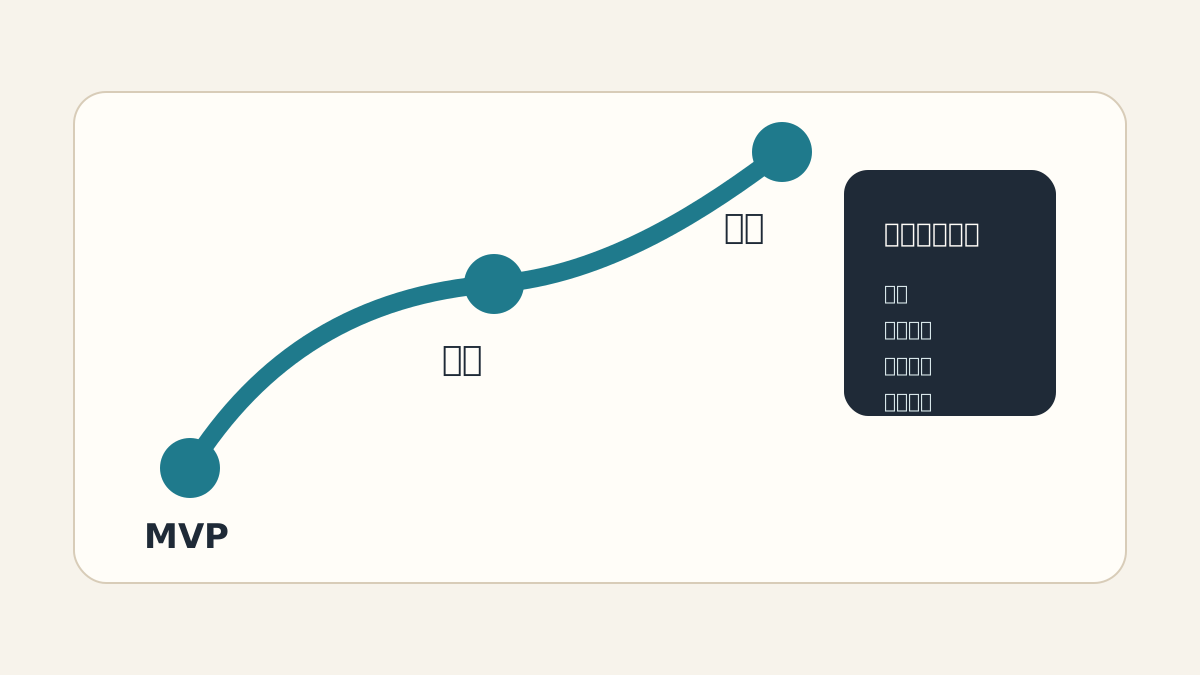
A genuinely useful MVP starts by finding the shortest possible core path: how does a user arrive, what's the one key action they need to complete, and how will your team know whether that action actually created value? If that path is clean, the first version has already done its job.
The same logic applies to the technical side. If a mature framework and a simple architecture can get the product running, don't reach for maximum abstraction in version one. Pull the system toward scalability once real signal shows up — that's usually more realistic than designing for every hypothetical from day one.
Why founders overestimate what version one needs to do
Many people treat an MVP as "a smaller version of the real product," so the first planning session already includes discussion of future permission models, multi-tenant architecture, advanced reporting, even a recommendation engine — sometimes for flows that haven't even been validated yet. None of that is impossible to build. The problem is that by the time it's done, the actual market question still hasn't been answered.
What actually needs answering upfront is a short list: who is this for, will they complete one core action, and once they do, can you clearly tell whether the product created value? If those three things are still fuzzy, more features just mean the cost shows up earlier.
When scoping an MVP, find the shortest validation path first
For a typical SaaS product, version one usually just needs the main flow to work smoothly — sign up, create a first record, complete one core task, get feedback on the result. As long as that spine is clear, a lot of things that feel "important" can wait. Advanced permissions, granular settings, complex notification rules — these are rarely what's actually blocking version one.
The same logic applies to technical decisions. The point of MVP-stage architecture isn't to show off — it's delivery speed, stability, and room to adjust later. Standing up the basics with a mature framework is more realistic than chasing the ideal microservices, event-driven, or highly abstracted component design from the start. Before you have real users, you simply can't know which extension points are actually worth investing in.
Another common trap is treating design and development as if they need to match final-product spec from day one. That pushes every page toward completeness and every state toward being fully handled, which stretches the timeline as a matter of course. For an early-stage product, it's far more valuable to get users to the core value quickly, then decide what to add in round two based on what they actually do.
A good MVP architecture isn't about showing off — it's about validation speed
So the right standard for scoping an MVP isn't "what can we cut," it's "what's indispensable to validating value." If real users can complete one key flow end to end, and the team collects a signal it can actually act on, version one has succeeded. Everything after that has direction, and is far less likely to burn resources chasing the wrong assumption.
In practice, teams that do MVPs well aren't the ones with the most complete plan going in — they're the ones who get real usage into the loop earliest. Once a product is live, being used, and hitting friction, the priorities for both engineering and features start to become obvious on their own. That's why a good MVP is never really about the feature list. It's about how fast you can validate.