AI Can Already Write Code — So Why Do We Still Recommend Hiring Someone In-House at a Certain Stage?
AI and outsourcing can cover capability and speed. But once a system can't afford downtime, once the founder's time is being eaten by upkeep, once customers start asking about reliability — what the business needs may be someone in-house who's willing to own it with you.
A question we get asked a lot lately:
"AI is so good at writing code now, and there are so many SaaS tools — do we even need to hire an engineer anymore?"
The people asking usually aren't indifferent to tech. Quite the opposite — they're staring at a stack of subscription bills, a pile of outsourcing quotes, and their own late nights fixing the system, and that's exactly why the question comes up.
We completely understand that exhaustion, and the instinct to be careful about adding one more line item to payroll.
But whether to hire your own technical person was never really a question of "can they write code."
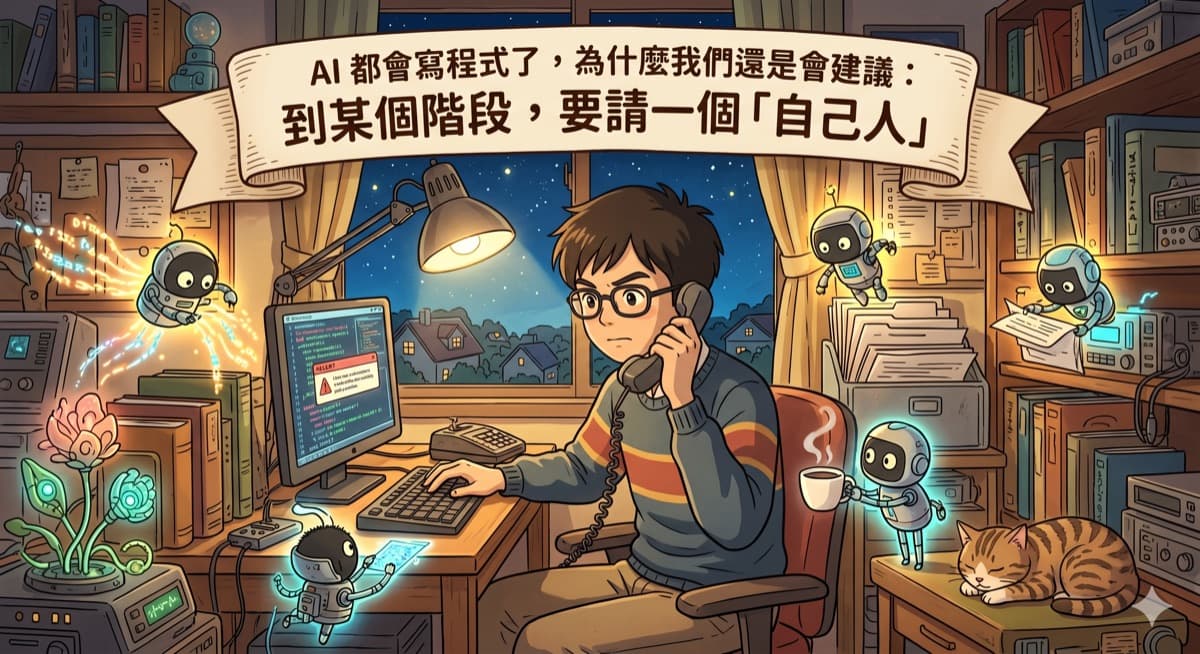
Your own person isn't the strongest engineer — they're the one who picks up the phone
Outsourced engineers are good. They've shipped dozens of projects and seen more landmines than we ever will. AI tools are remarkable too — they can spin up a working back office in ten minutes.
But there's one thing neither of them can do: at nine on a Saturday night, when payments suddenly start throwing 500 errors, jump off the couch, open the laptop, and be anxious about it with you.
That's not a technical problem. It's a question of who's willing to carry it.
An outsourced contractor has ten other clients — you're one of them. An AI tool can give advice, but it won't shoulder the risk with you. Only someone in-house treats your business like their own business at the moment something breaks.
And whether that late-night call gets picked up is often what decides whether a customer comes back.
Three signals: it might be time
When does a business actually reach the point of needing someone in-house? We've slowly picked out three signals.
Signal one: the system starts having moments it "can't afford to go down." Anniversary sales, year-end campaigns, that one critical ad push — if the system breaks during one of these windows, you don't just lose that day's revenue, you lose the next three months of repeat purchases. If your business already has stretches where downtime is unacceptable, that means it needs someone who is absolutely reachable, watching over it.
Signal two: you no longer have time to maintain it yourself. In the early days, one person can carry everything — write the copy, answer support, tweak the website, check the reports. But as the business grows, every role needs more depth, and "the founder who also does tech on the side" slowly becomes the bottleneck for the whole team. What's actually stuck isn't the technology. It's the founder's time.
Signal three: customers start asking, "Can we trust your back office?" B2B clients ask how data is stored. Larger accounts ask who's accountable if something goes wrong. Investors ask about IT risk. Underneath all of these is the same question: "Do you actually have someone who understands this?" Some trust only holds if the answer is "yes, we have our own person."
(Hitting any one of these three signals doesn't mean you did something wrong — if anything, it means the business genuinely grew into that stage.)
But "your own person" doesn't have to mean full-time
A lot of people assume "hire your own person" means "hire a full-time engineer starting at a hefty monthly salary," and that threshold alone is enough to send them straight back to outsourcing.
But we've seen plenty of more flexible arrangements:
Some upgrade an outsourced consultant into a semi-long-term partner — fixed hours each month plus priority response. Some bring on a technical co-founder, tying long-term commitment to equity plus a modest salary. Some start with a part-time technical assistant who handles daily upkeep and AI tool integration, while leaving major decisions to an outside advisor.
The point of "your own person" isn't the employment structure — it's whether they're willing to carry it with you. Some people are paid well but still show up with an outsourcer's mindset. Some work very few hours but are the first to jump in when something breaks.
Hiring your own person is, at its core, about finding someone who's willing to stand on your side the moment the system goes down.
AI isn't here to replace that person — it's here to amplify them
One last thing, since it comes up constantly these days.
AI tools are genuinely strong now. They can write 70% of routine code, organize requirements, and help track down bugs. But they won't judge how much a refund should actually be when a customer wants their money back. They won't know that a stuck workflow traces back to a rushed decision made two years ago. They won't know that before an important meeting, the owner just wants one chart, not a long report.
AI is an amplifier. It can let one person deliver what used to take three. But without that person in place, AI just sits alone in the subscription list, waiting to be cancelled.
So instead of asking "do we still need to hire, now that we have AI," the more useful question is:
"Do we have someone who will treat this business as their own, and who's willing to get stronger alongside AI?"
Closing: hiring your own person means hiring someone willing to see it through with you
Outsourcing covers capability. AI covers speed. Your own person covers ownership.
All three matter, but none of them can substitute for the others.
At some stage, every business reaches a point where no amount of tooling, and no stack of outsourcing quotes, can add up to the peace of mind it actually needs.
That's usually the point where it's time to hire your own person.
It doesn't have to be full-time, and it doesn't have to be the strongest engineer around — just someone willing to pick up the phone at nine on a Saturday night and say, "Let me take a look. Give me ten minutes."
For what it's worth, we bring this up not because it's urgent, but because it's the kind of thing that's easy to keep putting off until it's suddenly too late. Take your time thinking it through — just don't pretend the question isn't there.