The More Tools You Wire Together, the More Fragile the System Gets: Knowing When Not to Integrate Is the Real Skill
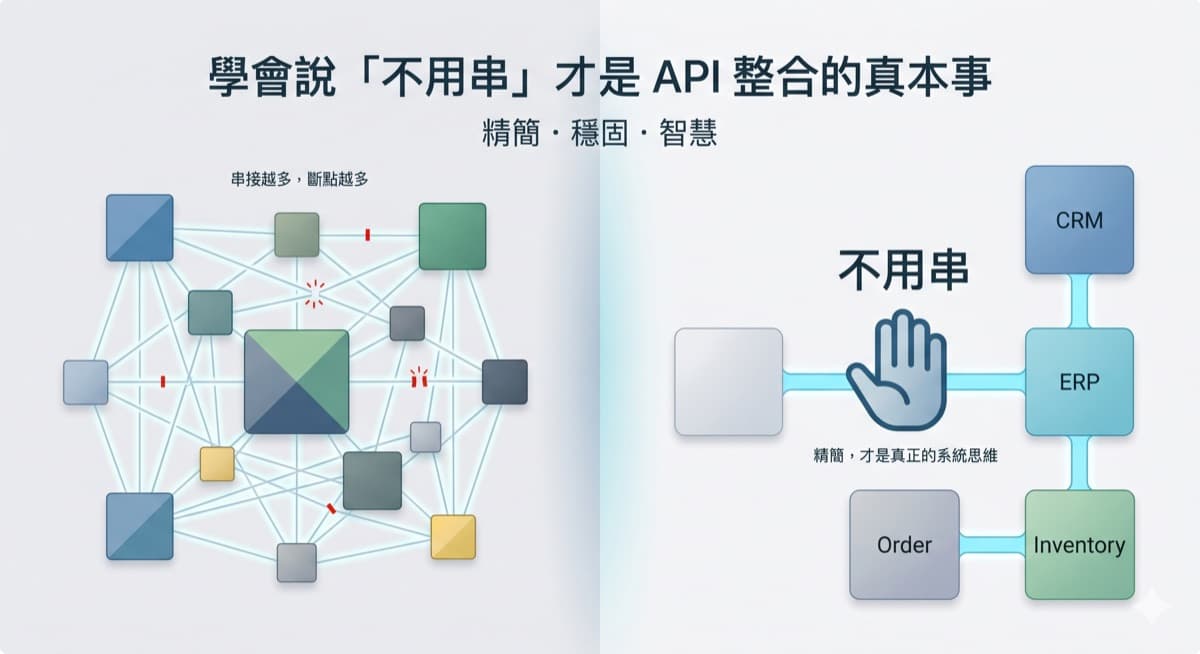
More API integrations isn't automatically better. Every connection is a line you now have to maintain. Real systems thinking means judging frequency, risk, and stability first — then deciding which processes are worth wiring up, and which should stay manual with a human checkpoint.
For a while, the most common line we heard in any systems-planning conversation was:
"Can these two systems talk to each other over an API?"
People asking that always had a certain gleam in their eye, a note of anticipation — as if wiring every tool together would make the business run itself, data sync seamlessly, and everything just click into place from then on.
We get that feeling completely. The first time we heard the phrase "API integration," the picture in our heads was genuinely beautiful: orders come in from the website, write automatically into the ERP, finance reconciles itself, the warehouse deducts inventory automatically, customers get an automatic confirmation email — everything meshing like gears.
Reality usually looks a bit different.
The more you connect, the more breakpoints you create
There was a premium skincare brand whose founder was genuinely passionate about technology. They ran an e-commerce platform, a warehousing system, a CRM tool, a newsletter platform, accounting software, and a custom-built membership back office — five systems, all wired together through APIs.
At first glance, that architecture looked impressive. Then one day, the newsletter platform pushed an API version update and dropped support for the old one. The connection broke. The newsletter stopped going out for three days before anyone noticed, because nobody happened to be watching that piece during that window.
They fixed the newsletter, and then the accounting software started throwing reconciliation errors because an order field format had changed.
They found someone to fix the reconciliation, and then the CRM's customer tag sync started drifting.
Every time one thing got fixed, something else broke. The whole system behaved like a spider's web — pull one thread loose, and the entire web shakes.
This wasn't that brand doing anything wrong. It's simply what happens once you wire too much together.
Why we love integrating everything so much
In these years of the AI tooling boom, new SaaS products show up every few months: a better CRM, a smarter newsletter tool, a more convenient support system. Every single one has an API, and every single one claims it "integrates with everything else."
It's easy to get pulled in by that narrative: the stronger the tools, the stronger the system once they're all connected.
But the problem is, every API integration is a line you now have to maintain. Just because the connection works today doesn't mean it'll still work in three months. Tools get updated, fields change, API versions get deprecated — these are all things that genuinely happen.
The more you integrate, the higher the maintenance cost, and the higher the odds something breaks.
What actually makes an integration worth it
We usually recommend clients ask themselves three questions before deciding whether to build an API integration.
First: how frequent is this?
If data only needs to sync once a month, copying and pasting by hand might genuinely be faster than maintaining an API. API integration is designed for high-frequency, repetitive actions. If something only happens once a week, the time cost of maintaining the API can easily exceed the labor it was meant to save.
Second: if this goes wrong, how bad is the fallout?
Some integration failures just mean data arrives a day late — no big deal. Others directly hit payments, orders, or customer experience. The latter is worth integrating carefully. The former can wait and see.
Third: are both systems actually stable?
A newly adopted tool, or a SaaS product still in its evaluation period, isn't something to rush into an API integration with. Wait six months, confirm the tool is here to stay, then integrate. Wiring up a tool you end up replacing later is wasted work.
Manual first, automated later is often the pragmatic choice
There was an online course team where, early on, every time a student enrolled, someone had to manually copy their info from the registration system into the student management back office. That took roughly twenty minutes a day.
They asked us whether they should build an API integration.
Our advice at the time was: keep doing it manually for three months first, confirm the process is stable and every field is right and both systems are staying put — then integrate.
Three months later, the process had indeed stabilized, and they'd also discovered a few edge cases they hadn't anticipated — like how to handle a student's status after a refund. If they'd built the API integration on day one, it would have made the integration itself more complicated and more error-prone.
By the time they actually wired it up, it went in far more cleanly.
"Manual first" isn't a lack of technical know-how — it's the smarter move. It recognizes that in an uncertain period, a human can adapt on the fly. An API can't.
Some tools were never meant to be connected
There's another case worth mentioning: some tools, even if technically connectable, shouldn't be connected on logical grounds.
For example, wiring a CRM directly into a warehouse system so that any edit to customer data automatically triggers changes to the fulfillment flow sounds convenient — but it removes a confirmation step in the middle. If someone fat-fingers an edit, what gets affected isn't just data. It's a real shipment.
The connections between systems sometimes need a human checkpoint as a buffer — not because the systems aren't good enough, but because human judgment genuinely belongs at certain points in the process.
Restraint is real systems thinking
The healthiest systems we've seen are rarely the ones with the most integrations. They're the ones that only wire up the handful of connections that genuinely matter.
Core processes — orders, payments, inventory — integrate them properly and maintain them carefully. Everything peripheral, test the waters first with manual work or a low-code tool like Zapier, and only integrate seriously once value and stability are confirmed.
Less isn't automatically weaker. Sometimes less is the stronger position.
The same thinking applies to systems.
API integration is a capability. Knowing when you don't need it is the actual wisdom.
Honestly, we're still practicing this ourselves — every time we resist the urge to wire up some tempting-looking API, it's its own small exercise in restraint.